Ecosystem Integration: Scaling the FIFA World Cup Experience Across 6 OEMs

1. Overview & The Challenge
During the upcoming FIFA World Cup 2026, our business objective is to maximize user engagement and high-eCPM ad revenue by embedding real-time match data directly into the native UI of 6 major partners (OEMs).
As the Senior Product Designer leading this B2B2C integration, I faced a complex architectural challenge. Our core offering—a highly monetized Landing Page featuring live data, ads, and a curated newsfeed—was packaged uniformly to scale efficiently. However, each of our 6 OEM partners enforced strict, unique design guidelines for how and where our entry points could live within their native operating systems. I had to design 6 bespoke user journeys that funneled users seamlessly into our standardized destination without causing a jarring transition.
2. Managing the Ecosystem: The Baseline Architecture
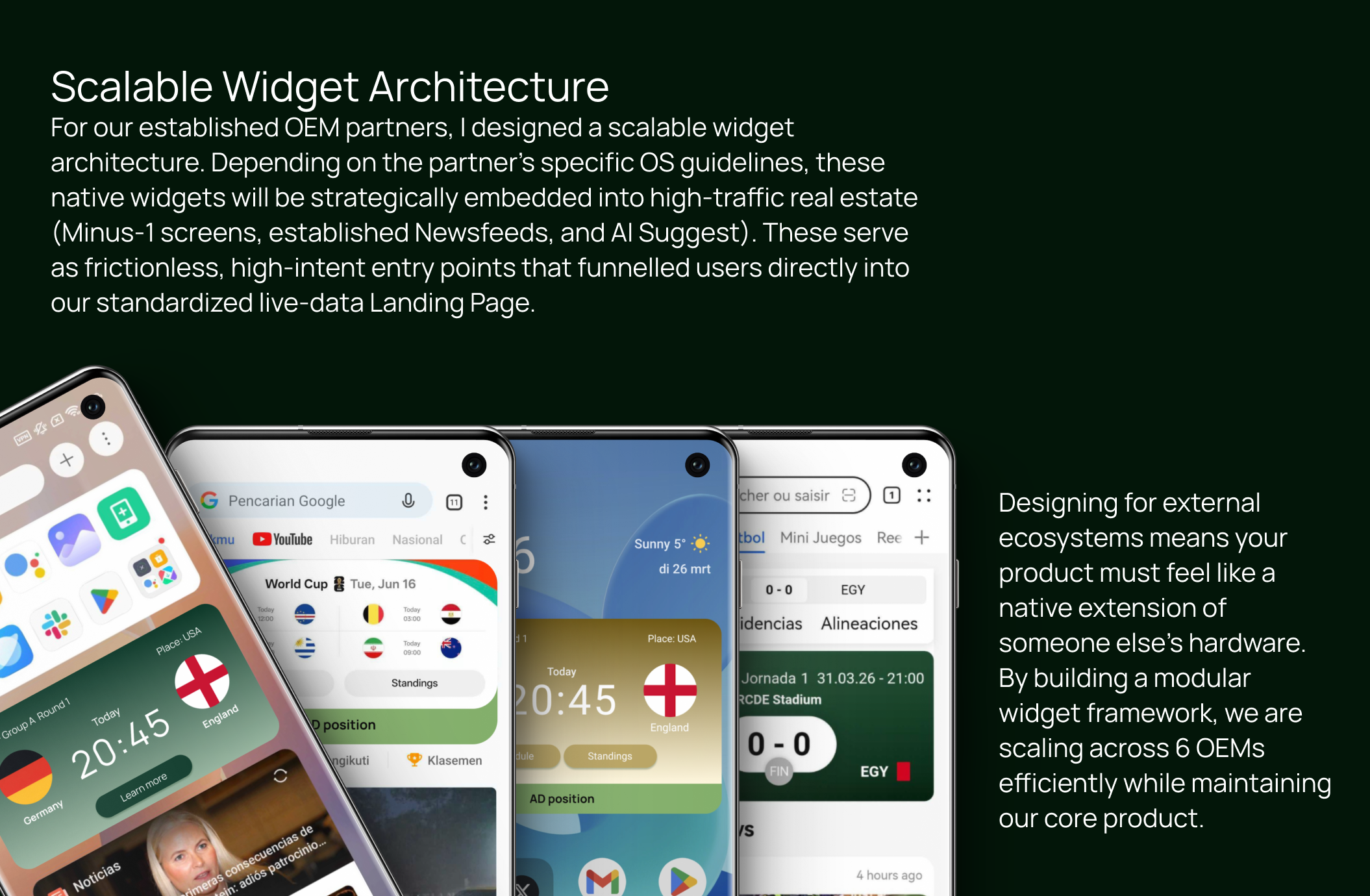
For our 5 established OEM partners, I designed a scalable, modular widget architecture. Depending on the partner's specific OS constraints, these native widgets were strategically embedded into high-traffic, native real estate—including Minus-1 screens, established Newsfeeds, and AI Suggest. These serve as frictionless, high-intent entry points that felt like a natural extension of the user's hardware.
3. Navigating New Partnerships: The Motorola Challenge
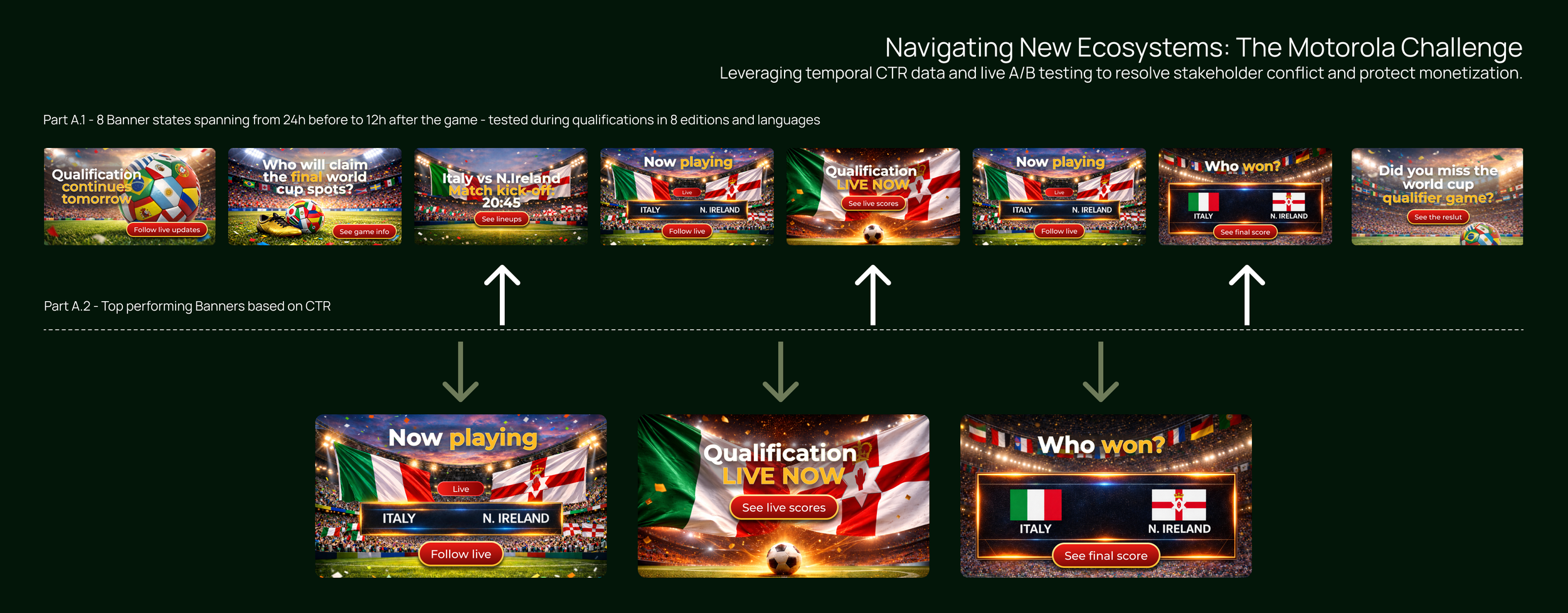
While our widget strategy scaled beautifully for existing partners, spearheading the integration with a net-new OEM (Motorola) presented a unique hurdle. Because their native NewsFeed was newly placed and buried in the App Drawer, a standard widget would not drive enough visibility. I successfully negotiated a high-visibility, top-of-feed banner placement to serve as our primary monetization funnel.
Scaling Through Temporal Testing: To optimize this placement, I conducted temporal CTR testing during the World Cup qualifiers, experimenting with 7 chronological banner states. We identified the top 3 highest-converting timeframes (12h before, Live, and After), allowing us to efficiently scale the UX across 49 language editions.
Stakeholder Conflict & Data-Driven Compromise:
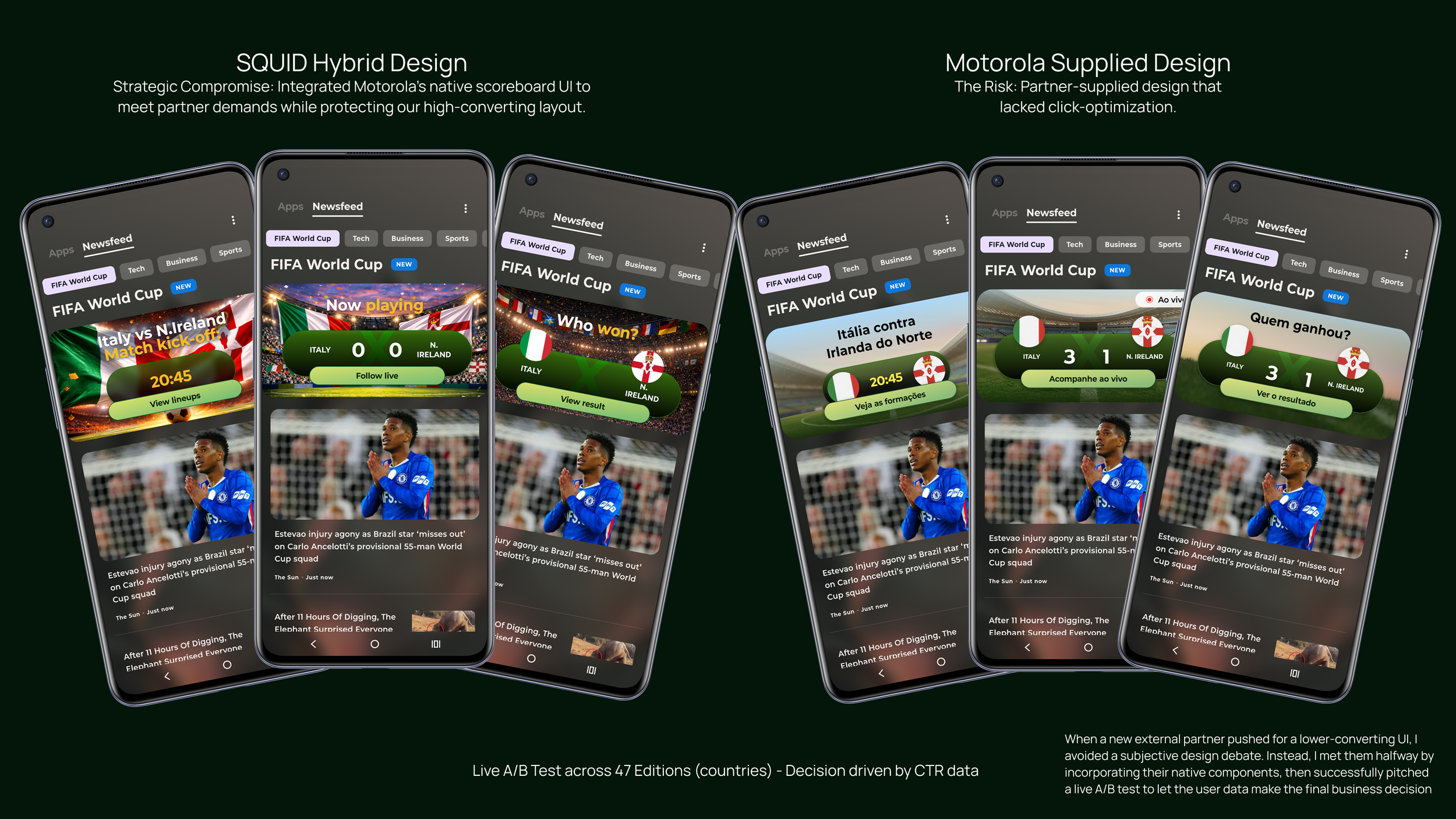
Right before rollout, Motorola stakeholders requested a more "native" UI match and supplied their own banner designs. To maintain the relationship without sacrificing our revenue potential, I engineered a strategic compromise. I integrated their native UI components (like their scoreboard) into our high-converting layout. Rather than debating subjectivity, I pitched a massive A/B test across 47 editions (SQUID Hybrid vs. Motorola Supplied). The final visual direction is strictly dictated by quantitative CTR data.
4. Context-Aware UI: Balancing UX & Monetization
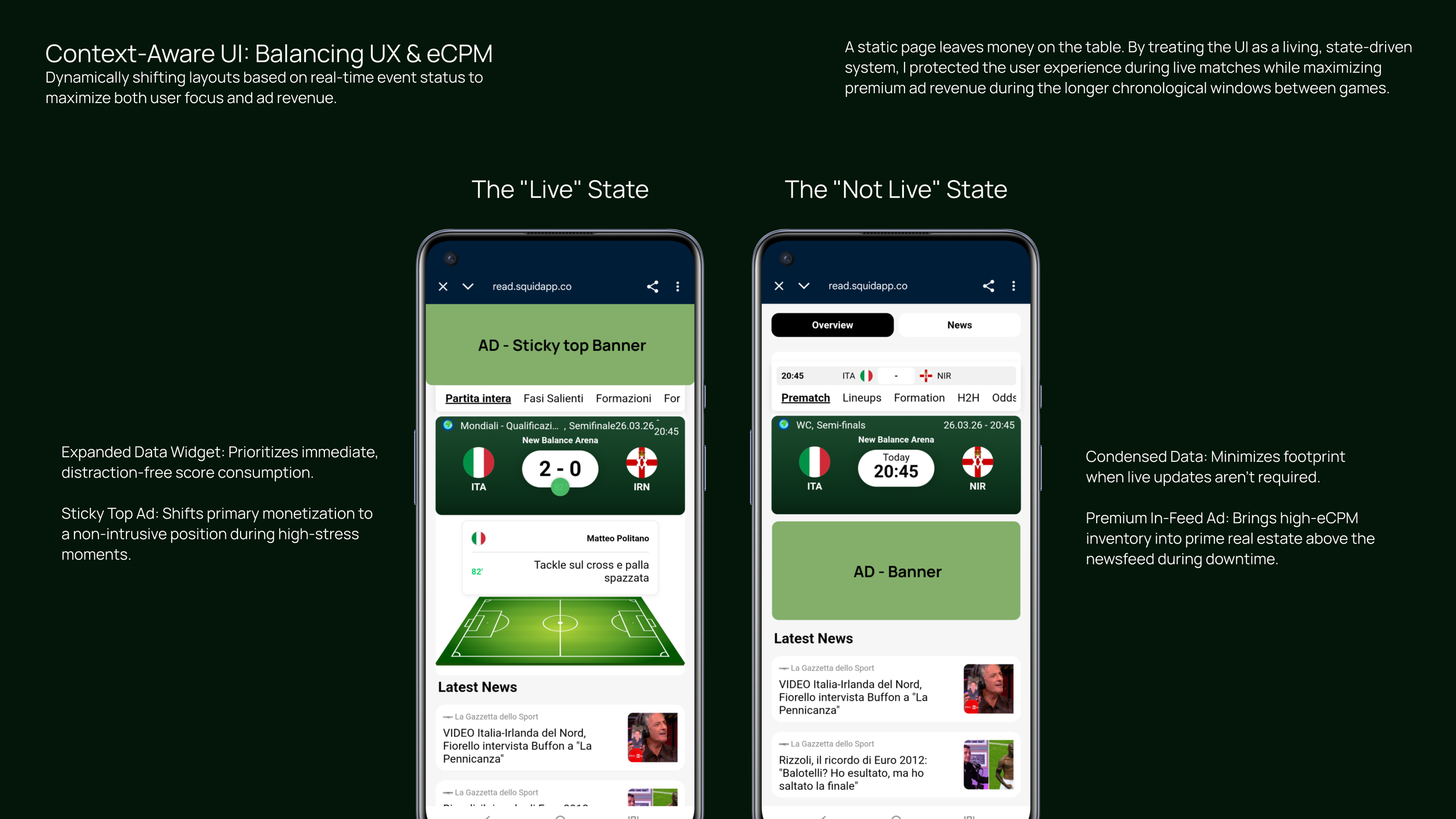
Once users clicked through the native OEM entry points, they arrived at our standardized Landing Page. I engineered this page as a responsive, state-driven system built on three modular elements: a JavaScript-integrated live data widget, strategic ad placements, and a localized web-based newsfeed.
To balance the user's need for focus with the business's need for revenue, the UI dynamically adapted based on the match status.
The "Live Match" State (Optimized for UX): The data widget expands to dominate the viewport for immediate data consumption. The primary monetization unit shifts to a non-intrusive sticky top banner to maintain a clean experience.
The "Not Live" State (Optimized for Revenue): Capitalizing on the longer downtime between matches, the data widget scales down. This brings premium, high-eCPM ad placements into prime visual real estate directly above the newsfeed, maximizing revenue without frustrating the user.
5. Global Scale & Localization
Because this event is a global phenomenon, the entire ecosystem architecture had to scale across 49 localized language editions. This required building a highly resilient UI framework, ensuring that the live data and ad placements remained perfectly stable regardless of the user's region. In total I will have created 700+ Banners for the Motorola FIFA activity.
6. Impact & Strategic Learnings
Defending the Mutual ROI: I learned that protecting core UX and monetization funnels is just as important as adhering to a partner's design guidelines. Fostering a click-optimized UI protected the revenue potential for both our business and the OEM.
The Art of Strategic Compromise: Mastered the delicate balance of B2B2C ecosystem design, successfully navigating the tension between brand identity and strict OS constraints by creating hybrid UI components.
Data as the Ultimate Negotiator: By leveraging business acumen to pivot a design conflict into a live, multi-regional A/B test, I ensured the final product direction was an objective, user-validated "win" rather than a subjective opinion.
Designing for the Long Game: I approached this high-stakes live event as a strategic proof-of-concept. Successfully balancing native integration, real-time data, and ad revenue served as the foundational wedge to secure long-term contracts as a permanent OS Newsfeed provider.