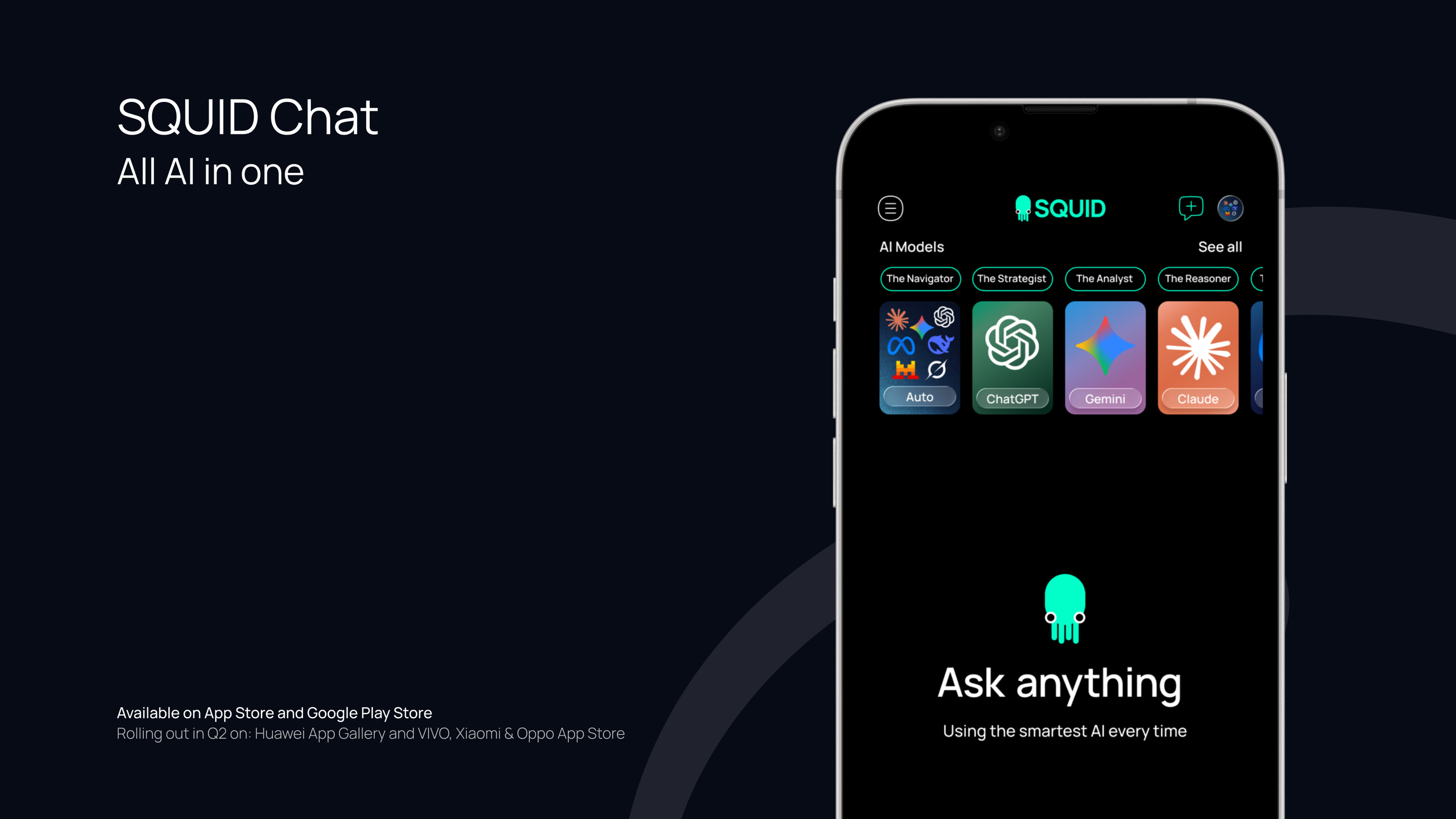
1. Overview & My Role
Over the past 9 months, I led the end-to-end product design and strategy for Squid Chat, a brand-new AI aggregator app. Operating seamlessly across multiple disciplines—acting as Product Lead, UX Researcher, UI Designer, and Go-To-Market Strategist—I guided this product from an initial concept to a validated, market-ready platform. My core objective was to build an intelligent, frictionless chat experience that removes the technical barrier to entry for everyday users.
2. The Problem & Validating Product-Market Fit
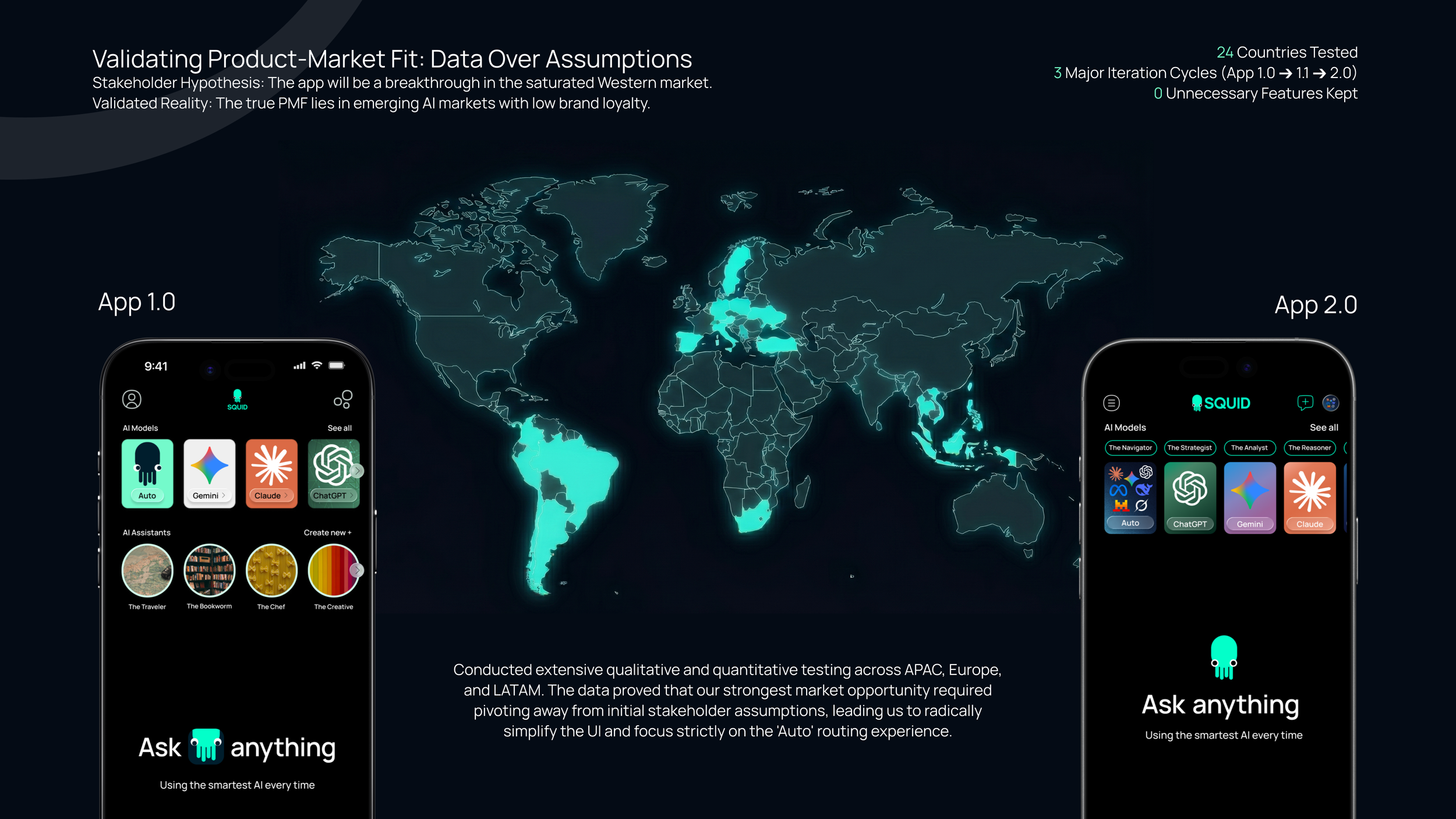
Initial stakeholder assumptions projected Squid Chat as a breakthrough tool for the saturated Western market, targeting "AI Power Users." However, as a Senior Product Designer, I know that assumptions must be stress-tested.
I conducted extensive global qualitative and quantitative testing, which revealed a completely different reality: Western power users were already fiercely loyal to existing single-model platforms. The true Product-Market Fit (PMF) lay in emerging markets (APAC and LATAM) among "AI Novices" who wanted high-quality answers without the steep learning curve. Armed with market data, I successfully defended this pivot, stripping away unnecessary features to focus entirely on frictionless simplicity.
3. The Core UX: Combating Decision Fatigue
The biggest hurdle for our validated target audience was decision fatigue. Presenting a novice user with a dropdown menu of 20 different AI models creates immediate friction.
To solve this, I designed the "Auto" routing function as the core of the MVP. Instead of asking the user to choose a model, the user simply types their prompt. The UI then displays dynamic, context-aware microcopy ("Choosing the best AI model for your political question...") while the backend API routes the prompt to the most capable model. Finally, the generated answer includes a transparent rationale ("Squid chose Gemini 3.1..."), subtly educating the user and building long-term trust in our aggregator's intelligence.

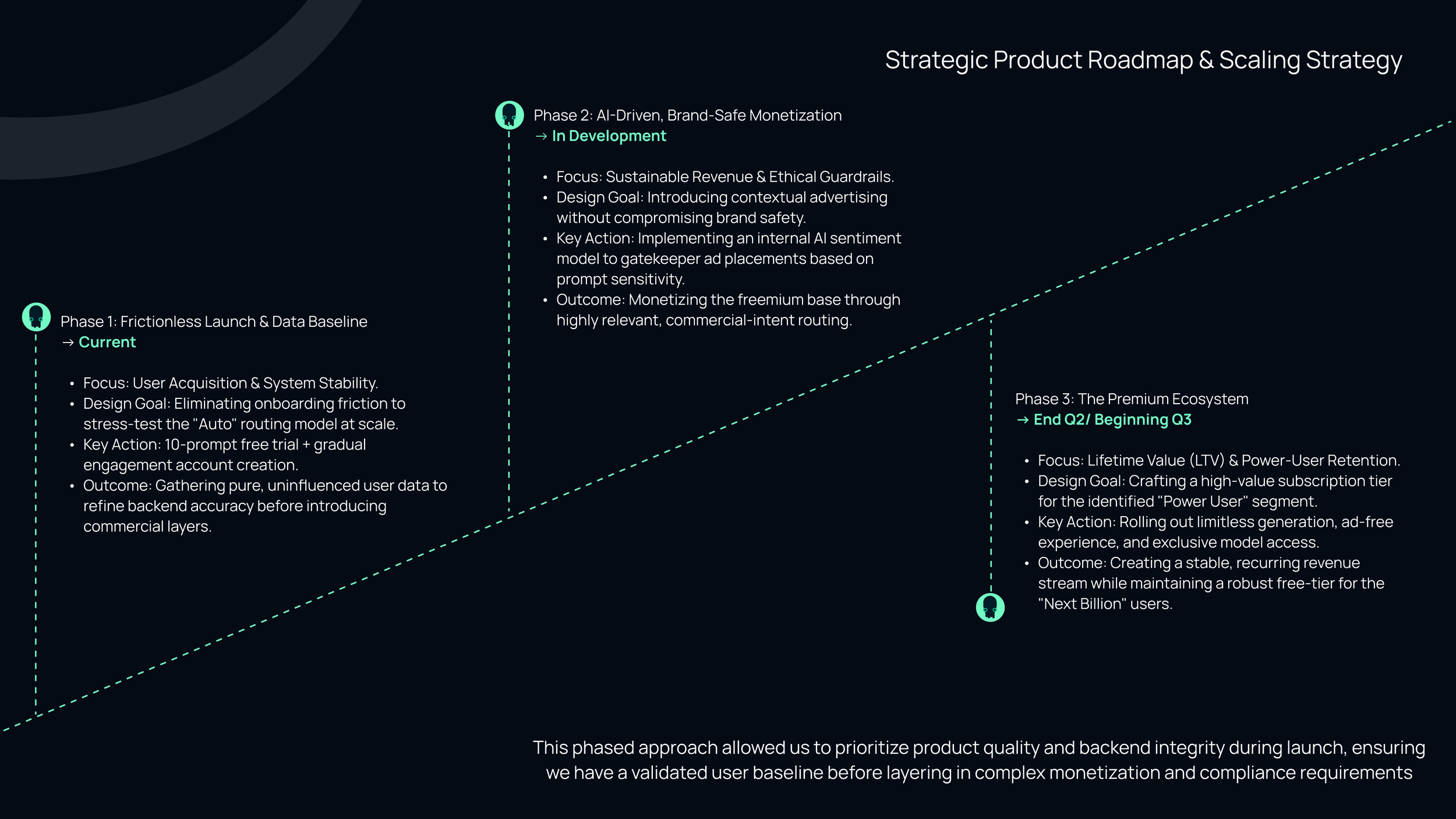
4. The Strategic Product Roadmap
To ensure a successful rollout, I structured the product lifecycle into three distinct phases. Rather than rushing monetization, I prioritized gathering uninfluenced data to refine our core routing technology.
5. Designing for Brand Safety & Monetization (Phase 2)
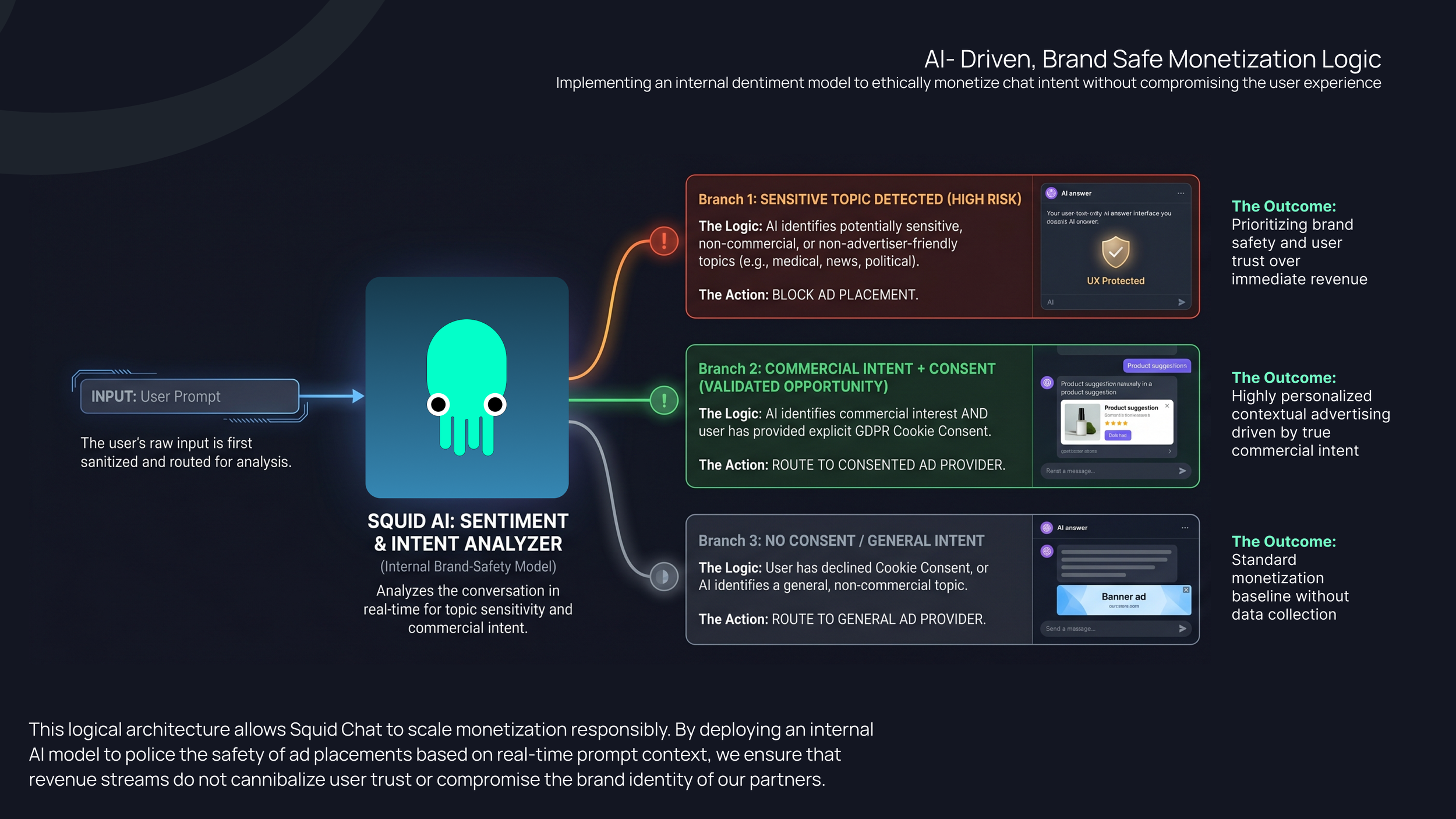
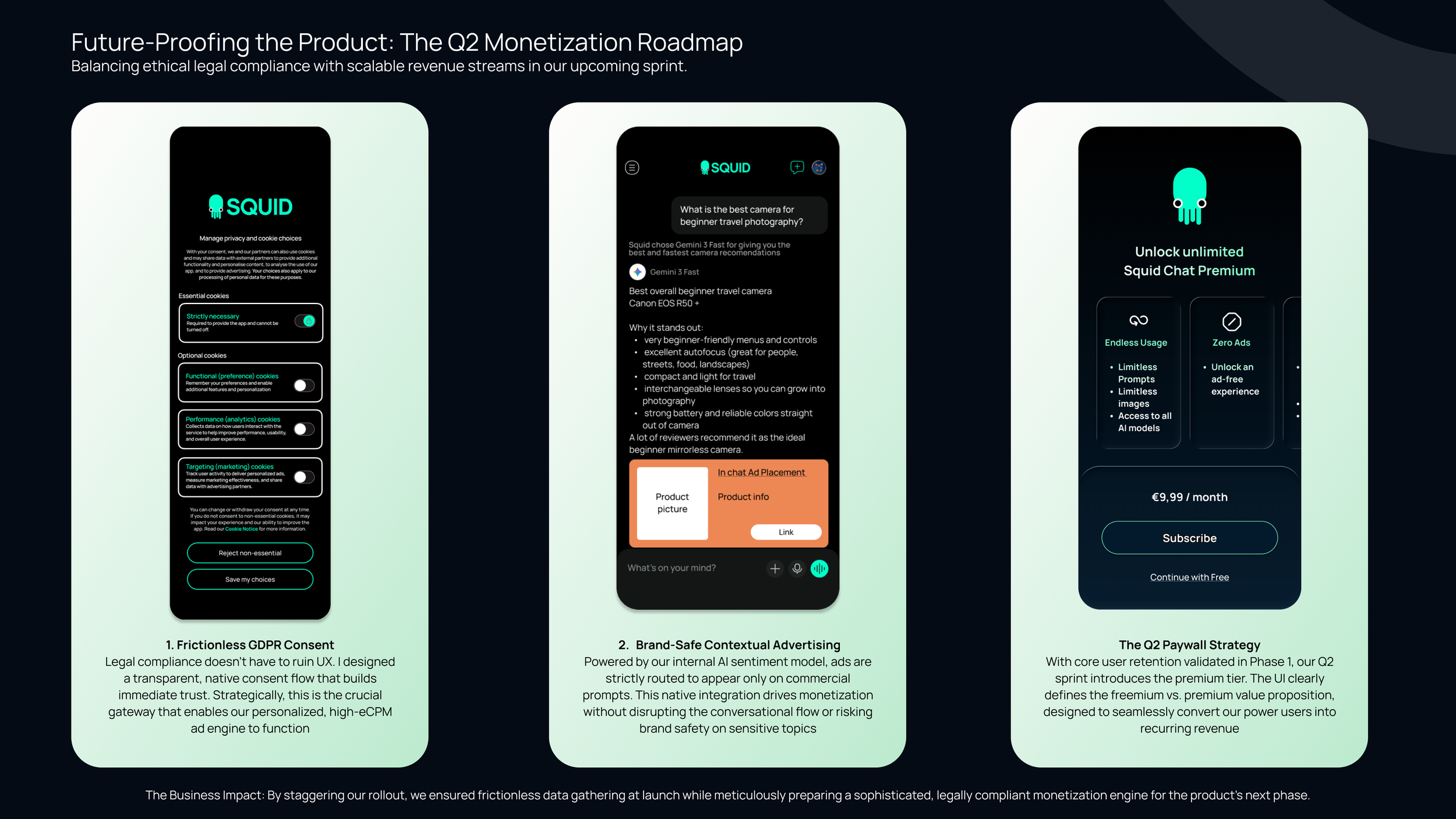
Introducing advertising into an unpredictable AI chat environment presents significant brand safety risks. To responsibly monetize our freemium user base in Phase 2, we are actively developing an internal AI Sentiment & Intent model.
This model acts as a gatekeeper. By analyzing user prompts in real-time, it blocks ads on sensitive topics (protecting user trust) while routing commercial-intent prompts to personalized, consented ad providers. This architecture proves that monetization and ethical UX can coexist.
6. Forward-Looking UI: Compliance & Premium Tiers
Legal constraints often degrade the user experience, but I viewed them as an opportunity to build brand credibility. I drafted our foundational Terms of Service, Privacy Notice, and AI Data Usage policies from scratch, seamlessly integrating them into a frictionless UI. Furthermore, the designs for our Phase 3 Q2 Sprint—a limitless, ad-free Premium Subscription—are fully validated and ready for implementation.
7. Go-To-Market & Ecosystem Acquisition
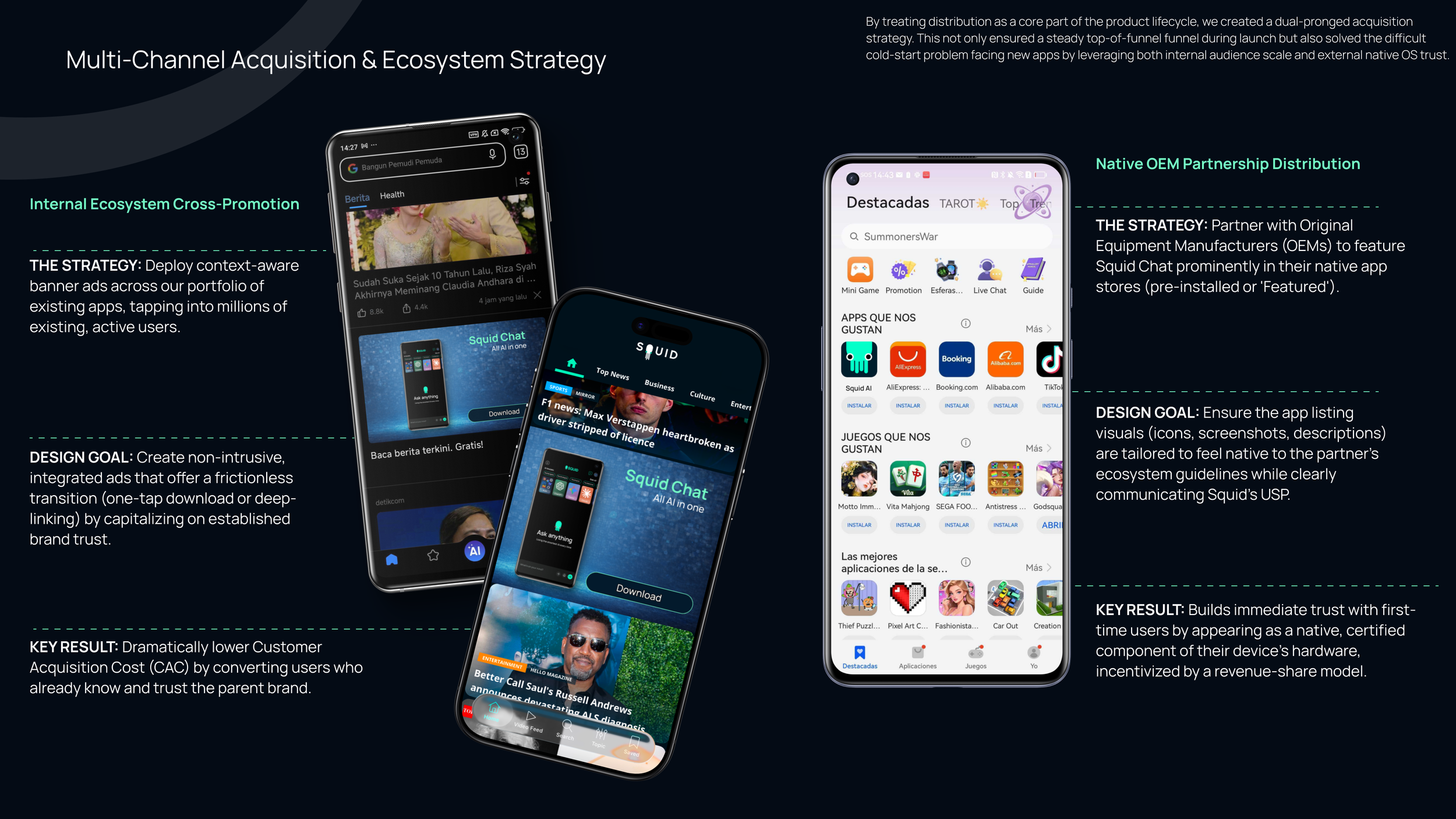
A great app is useless without distribution. To bypass the "cold-start" problem and drastically lower our Customer Acquisition Cost (CAC), I engineered a dual-pronged Go-To-Market strategy leveraging both internal scale and external partnerships.
By designing context-aware banner ads for our company's existing digital products, we tapped into an active audience of millions. Simultaneously, I designed native ecosystem assets for our OEM app store partners, securing highly visible placements backed by a strategic subscription revenue-share model.
8. Learnings & Takeaways
Championing PMF Over Assumptions: Successfully navigated stakeholder bias by utilizing rigorous global user testing to prove our true market lay in emerging AI economies.
Ruthless Prioritization: Resisted the urge to add "fancy features," scoping the MVP down to focus entirely on frictionless routing and backend answer quality.
Navigating Legal as a Trust Pillar: Took ownership of complex compliance requirements, drafting all foundational legal documents from scratch and weaving them into a seamless UX.
Future-Proofing Through Iteration: Established a validated baseline where future feature rollouts will be strictly driven by continuous A/B testing and user feedback loops.